
TT Club’s Quick Reference Guide For Miscellaneous Substances
We have been covering some of the TT Club’s new quick-reference guides on the safe handling of dangerous goods, as a continuation of that series we are now highlighting their key practices to follow – and avoid – when dealing with Miscellaneous Substances – or Class 9 dangerous goods.
Recognised globally, TT Club is a leading insurer and risk management specialist serving the international transport and logistics sector.
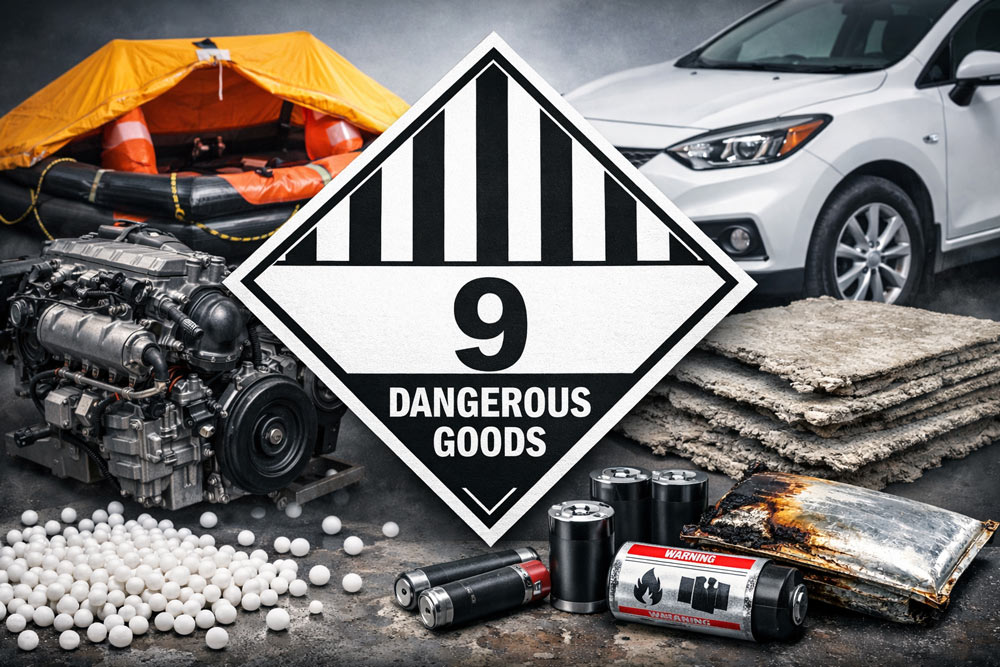
Class 9 is a catch-all category for dangerous goods that do not fit into other classes but still pose significant risks, including environmental hazards, marine pollutants, or substances requiring elevated temperature transport. Some may act as catalysts or accelerants for fire or explosion, requiring additional risk management.
Typical class 9 goods include:
- Internal combustion engines
- Self-inflating life rafts
- Vehicles
- Asbestos
- Elevated temperature substances (e.g., Bitumen)
- Polymeric beads
- PCBs
- Lithium batteries
TT Club Do’s and Dont’s
Packing
Do…
- Selecting appropriate packaging is important because of the wide range of substances and articles covered under Class 9
- Use only approved packaging or containers for Class 9 cargoes
Don’t…
- Use damaged packaging or containers
Storing
Do…
- Store in a well-ventilated and, where required, temperature-controlled storage facility
- Store with labels forward, heavy cargoes at bottom and correct orientation (arrows up)
- Inspect cargoes regularly to ensure condition remains stable and safe
- Alert the dangerous goods competent person immediately if any problems
- Ensure all employees are trained in emergency response procedures
Don’t…
- Store any Class 9 cargoes that could be a catalyst or accelerant of fire or explosion near to stairways, emergency exits or sources of ignition, such as electrical equipment or water
- Store near to sources of heat, such as a radiator
- Store old or uncollected cargoes, which can become more unstable over time
Transporting
Do…
- Ensure all relevant transport risk assessments are up to date
- Ensure all staff involved in transport have the relevant dangerous goods awareness training
- Contact the DG competent person if you have any questions or queries about transport
- Pack cargoes securely to avoid movement during transportation
- Familiarise yourself with and adhere to the relevant chapters of the CTU Code
Don’t…
- Allow any sources of ignition, such as electrical equipment, near any Class 9 cargoes that could be a catalyst or accelerant of fire or explosion
Always
- Follow the manufacturer’s instructions
- Remove lithium batteries that show any signs of blistering or bulging, or are hot when not in use, to a quarantine area for further checks
- Communicate clearly with those up and down the supply chain
- Maintain a documented emergency response plan that is regularly tested and, ideally, developed in collaboration with the cargo manufacturer
Never
- Expose Class 9 cargo to extreme temperatures
- Throw, drop, roll, slide or drag Class 9 cargoes at any point in the supply chain
- Ignore abandoned cargo – it must be safely removed and disposed of
Evolution Forwarding provide customers with compliant solutions for dangerous goods, specialising in end-to-end solutions for the safe and transport of these product types by air, sea, and road.
From packaging and documentation to regulatory compliance and staff training, our expertise helps shippers navigate these challenges with confidence. Contact us at info@evolutionforwarding.com or call 0800 4346244 to learn more.